Berkeley Institute opens
September 6, 1897
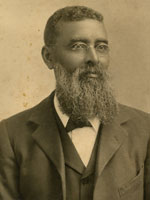
Berkeley founder Samuel David Robinson. Photo courtesy of Carol D. Hill.
A new era in education began when The Berkeley Institute opened at Samaritan’s Lodge on Court Street, Hamilton with 27 students.
Berkeley was the realization of a dream that began 18 years earlier when businessman Samuel David Robinson invited five men to his new home Wantley on Princess Street, Hamilton on October 6, 1879 to discuss the feasibility of opening a high school.
Six men joined the original five at a follow-up meeting on October 9. They established The Berkeley Educational Society, and spent the next 18 years raising funds and public support for the school.
The school was named after George Berkeley (1685-1753), an Anglo-Irish philosopher and Anglican bishop, whose plan to establish a college in Bermuda for native Americans a century earlier had foundered.
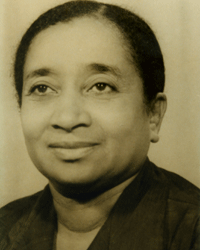
All but one of the 27 students were black, several of them the children of Samuel David Robinson. (See bio of Wenona Robinson.)
Five months after the school had opened, students were being prepared to take Cambridge exams (the forerunner of today’s GSCE’s) in scripture, Latin, French, English language and literature.
Overseeing their instruction was George DaCosta, who had been recruited from Jamaica to be headmaster of the Bermuda Collegiate Institute, which opened in 1892 as the first high school for black Bermudians.
But DaCosta fell out with the Institute’s trustees and was preparing to return to Jamaica when he was tapped by Berkeley founders to run their new school. DaCosta was headmaster for 37 years.
Berkeley became the leading high school for black Bermudians during the era of segregation. But the founders’ vision of a fully integrated school would have to await the passage of time and a more enlightened society.
All founders were black, but several whites played a key role in the school’s early beginnings. They included Rev. Mark James and John Barritt.
The 11 founders, in addition to Samuel David Robinson, were Joseph Henry Thomas, schoolmaster; Richard Henry Duerden, a dry goods merchant; Eugenius Charles Jackson, Bermuda’s first black lawyer; Charles William Thomas Smith, physician; William Orlando Bascome, dentist; John Henry Jackson, grocer and future parliamentarian; Samuel Parker, Sr. and Jr., publishers of Bermuda’s first black newspaper; Henry Dyer, a ferry-boatman, and William Henry Thomas Joell, a carpenter, who became Bermuda’s first parliamentarian in 1883.
In 2008 Government purchased Wantley, the home of Samuel David Robinson, for $2.5 million.
Source: The Berkeley Educational Society’s Origins and Early History By Kenneth Ellsworth Robinson
|
| Born this month |
|
Stanley Burgess
September 10, 1901-June 3, 1984
Marathon Derby legend, fisherman
|
 'Sir"'Stanley Burgess.
|
Stanley Burgess was one of the Island’s most enduring and colourful sports legends. A perennial competitor in the annual Bermuda Day Marathon Derby on May 24, he was a fixture in road running for 60 years.
His running prowess earned him a litany of titles. The diminutive champion, who stood only five-foot three, was known as ‘The Iron Horse’, ‘Mr. Marathon’ and ‘The Champ’.
Later, as his popularity increased with age, he was called ‘Grand Old Man’ of the Marathon Derby and even ‘Sir’ Stanley.
One of his biggest fans was former headmaster Dale Butler, who is now Culture Minister. When Butler was principal of Dellwood School, he set aside May 23 as a day for his students to celebrate Burgess’ achievements.
Handkerchief
Burgess ran his first marathon in 1921 and his last in 1983—13 months before his death at age 83. He always ran with his trademark white handkerchief wrapped backwards around his head, which added to his appeal.
His talent and homespun tips for winning helped contribute to the popularity of the Marathon Derby, which grew by fits and starts over the decades. It now attracts more than 500 entrants, thousands of spectators and is the signature event of the Bermuda Day holiday.
Burgess smoked two packs of cigarette a day—but claimed he didn’t inhale— and drank a “secret” potion of honey and liquor, but had an otherwise healthy lifestyle, literally living off the land and the sea.
He was a mason, who went fishing in his beloved cedar sailboat most days, and a beekeeper who also farmed a small plot. He always kept a pig. Flatts residents remember how he trundled a large wheelbarrow up and down Flatts Hill, filled with “pig’s meat” or kitchen scraps, for his pig.
He confined his running to the Marathon Derby, which dates back to 1909. The Derby, which was first run on May 24 in 1928, changed courses and dates several times, and even faced competition from a competing race.
Unofficial
Burgess first made his mark in the unofficial race, which he won three years in a row, beginning in its first year in 1926. Both races took place between 1926 to 1943.
When Burgess boasted in newspaper interviews that he had 10 first-place wins, 14 second-place wins, five third-place wins and three fourth-place wins, he was counting his finishes in both races. Because of the zigzag nature of the Derby over the decades, some of his finishes cannot be verified independently.
He won the Marathon Derby six times, according to the official records, a record that was matched by Ed Sherlock and which has since been surpassed by Kavin Smith, who won eight times.
Typhoid
Burgess was born and raised in Flatts, where he lived all his life. His parents were George and Odessa (born Harvey) Burgess. He contracted typhoid fever twice as a child, and credited his mother with nursing him back to health.
He ran five miles a day as a child from Flatts to South Shore and back during school lunch hours to take lunch to his father.
He trained as a mason under Eugene Harvey, a leading contractor of his day, but like many Bermudian tradesmen of his era, he could turn his hand to anything, including carpentry, laying tile and brick and boat building.
For many years, Flatts landowners William Zuill and Dr. Henry Wilkinson employed him to maintain their properties. Burgess lived with his wife Rosalie, whom he married in 1927, in a small cottage in Flatts.
Boxing
The first sport Burgess took up was boxing, but he dropped it in deference to his mother who said the sport would damage his eyes. Neighbours who knew of his love of running encouraged him to run in his first marathon.
Burgess was often asked about his running secrets. He said he exercised regularly, and didn’t eat “much food”, except when it came to vegetables—beet greens, okra, pawpaw, spinach and cauliflower—which he grew himself.
Burgess put honey he harvested from his hives in cereal, tea and drinks. The real secret of his success, he confided to journalists, was his Runner’s Honey Cocktail. “I don’t tell nobody what I put in it,” he told the Bermuda Sun in December 4, 1971. “It’s different kinds of liquor and honey.”
As young man, he filled up on custards made with goat’s milk and duck eggs, but when goats and ducks were hard to come by, he switched to cow’s milk and chicken eggs. He also drank a variety of fruit juices and took vitamins.
Source: The May 24th Bermuda Marathon Derby Classic—All the Facts, Winners and Drama By Dale Butler. Additional research by Don Burgess.
|
|
Previous Bermuda Biographies home pages by month:
|
|
Jazz on the block
Hubie’s Bar on Angle Street is the location for this month’s Historical Heartbeats lecture ‘Jazzin’ on the Block’. Musician Ron Lightbourne will be the man at the mic, with music by The Unit. It gets under way at 7pm on Thursday, September 17 and the event is free. Call Dr. Kim Dismont Robinson of the Department of Culture at 292-9447 for more info.
Spotlight on the push for change
Bermudians scholars Dr. Clarence Maxwell and Theodore Francis will be presenting a lecture on Thursday, September 17 at 7.30pm about the fight for black equality in the years preceding Emancipation. They will highlight the efforts of black religious teachers in the early 19th Century. The lecture, which is a presentation of the Bermuda Archives, will take place at the Wesley Methodist Church’s Dyer Hall.
New name for Spanish Rock
A ceremony to change the name of Spanish Rock to Portuguese Rock is to be held on Friday, September 25, at 4pm the World Heritage Centre in St. George’s. The name change comes as a result of recent revelations that it was a Portuguese sailor, not a Spaniard, who wrote the year 1543 on a rock at Spittal Pond more than 400 years ago. Contact the Department of Community and Cultural Affairs in 292-1681 for more information.
Celebrating 400 years of art
A new exhibition celebrating 400 years of art in Bermuda has just opened at the Bermuda National Gallery (BNG). Look for Gleeson dolls, maps, cedar furniture and portraits at ‘4 Centuries: Evolving Art’, from the collections of the BNG and the Bermuda National Trust. For more info, log on to www.bng.bm.
Foster’s mural a ‘landmark’
Graham Foster’s mural depicting 400 year of Bermuda’s history has been hailed as a “a landmark”. Artist and critic Charles Zuill wrote in a recent review that the mural is “a landmark” in Bermuda’s history and requires several viewings in order to truly appreciate it. The mural ‘Bermuda’s Story in Art’ is located at Commissioner’s House in Dockyard.
Sailing with Masterworks
Masterworks Museum’s latest exhibit ‘We are Sailing’ explores Bermuda’s nautical history. It opened in June and will run the rest of the year. Click on to www.bermudamasterworks.com for more info.
^ Back to top
|