- Biography
- Milestones
- Quotes
- Photos
- Learn More
Samuel Seward “S. S.” Toddings Sr.
April 16, 1847-April 24, 1935
Pioneering publisher and editor, parliamentarian |
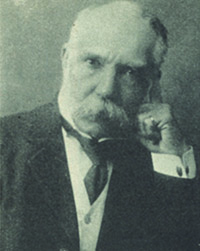
Photo courtesy National Museum of Bermuda
| S.S. Toddings Sr.—the son and grandson of former slaves—was the founder and long-time editor of the Mid-Ocean News and the most prominent newsman of his generation.
During his 65-year career as publisher and editor, first of the Colonist then the Mid-Ocean, he courted controversy for his strong opinions and earned respect for his courage. He was sued at least twice for libel, and spent several days in jail for refusing to reveal a source.
Toddings was the first publisher to print full reports of parliamentary debates, which allowed for greater transparency into local politics. He was also a Member of Parliament, and a church organist, first at St Peter’s in St. George’s, then at St. Theresa’s in Hamilton, following his conversion to Catholicism.
Most intriguingly, he was the son and grandson of former slaves—a fact that has only recently come to light. His black ancestry was apparently an open secret during his lifetime, according to historian and former Royal Gazette editor William Zuill.
But he was able to cross the racial divide in segregated Bermuda and live as a white man.
Slavery
Toddings was born in St. David’s, the eldest of five children born to Charlotte (Outerbridge) Musson and Thomas Toddings. Thomas Toddings, a white Bermudian, had a variety of occupations. He was a schoolteacher and later became a grocer and a successful auctioneer in St. George’s.
S.S. Toddings’ mother was born Charlotte Outerbridge, but later adopted the surname of Musson. She was the daughter of Rebecca Outerbridge. Both Rebecca and Charlotte were born into slavery, but were freed prior to Emancipation in 1834. Despite the one-drop-of-black-blood rule that prevailed in Bermuda, Toddings, who looked white, did not appear to encounter any economic barriers because of his black ancestry.
He achieved a level of education that was rare for Bermudians of his era, black or white. He received his high school at the Military School in St. George’s and then attended Mount Allison University in New Brunswick, Canada, where he graduated with a B.A. degree in 1866.
At Mount Allison, Toddings met his first wife, Jane Allison, the daughter of a professor, Henry Allison, and a niece of Mount Allison’s founder, Sir Charles Allison. The couple were married in New Brunswick in 1876. Jane died in Bermuda in 1888.
In 1891, Toddings married Agnes Costello of St. George’s, with whom he had two sons, Seward Jr. and Thomas. He converted to Catholicism following his marriage to Agnes.
Purchased
Toddings began his “meteoric career”, which is how the Bermuda Recorder described it, as a junior reporter at the Halifax Herald, where he worked for three years.
Upon his return to Bermuda in 1869, he and his brother Lindsay purchased the Colonist newspaper, which had been in existence for three years and was published in St George’s.
Shortly after talking over the newspaper, the brothers increased publication from every two weeks to weekly. In 1871, Toddings began publishing full reports of parliamentary debates. He travelled from St. George’s to the House of Assembly in Hamilton, dressed in formal attire, including a top hat, according to William Zuill. He eventually received a government grant for his efforts.
In 1882, he became sole owner of the newspaper, and three years later, moved its operations to Hamilton. In 1907, with the formation of the Colonist Press Company, Toddings became a principal shareholder and continued on as editor. In 1911, he quit following a dispute with the directors and started the Mid-Ocean the same year in August.
Elected to Parliament in 1904, he served in the House until 1911 when he lost his seat. His defeat was attributed to his support of a subsidy for the Quebec Steamship Company to provide a regular ship to St. George’s.
Publication
The Mid-Ocean’s first issue, a four-pager printed on pink to distinguish it from the competition, came off the presses on August 12, 1911.
A year after starting the Mid-Ocean, Toddings hired an American business manager with 30 years’ experience in the print industry. Toddings put out the paper with a staff of two. His elder son and namesake helped out during school holidays. Toddings remained with the newspaper for the rest of his life. The Mid-Ocean initially published twice a week, later increasing publication to three times a week. Meanwhile, he served in Parliament for five more years, from1923.
Toddings had strong opinions and did not shy away from expressing them, either in the House of Assembly or in his newspaper. He backed a railway for Bermuda and was critical of government for dragging its heels getting it up and running. Bermuda would not have a railway until 1931, four years before his death.
He supported widening Town Cut channel to allow bigger ships into St. George’s, which was highly controversial. He was vindicated with the arrival of the bigger ships, which were a boost to the economy.
In 1907, not surprisingly for a college-educated man, he expressed strong support in Parliament for raising for the school-leaving age to 14. His views fell on deaf ears. Bermuda would not raise the school-leaving age beyond age 13 until the 1960s.
Libel
He was sued for libel twice. He lost the case in 1874 (and went to jail for refusing to reveal his source) during his tenure as editor of the Colonist. He was more successful in 1919 with the second libel case, which was thrown out of court.
In addition to being an MP and a church organist, Toddings was chairman of St. John Ambulance. He followed in his father’s footsteps and served as Overseer of the Poor. He fell afoul of unsympathetic east enders for playing a key role in the construction of a “poor house” in St. George’s to house destitute seniors.
As for his black ancestry, while it was never mentioned publicly, he did not cut ties to his black family in an attempt to hide it. He was close to his mother and grandmother and the only surviving Mid-Ocean issues—for the year 1912—point to prominent coverage of black events.
A mass celebration of the Island’s black lodges and an AME church conference made the front pages as did the graduation of black Bermudian nurse Mary Tucker from the Lincoln Hospital School of Nursing in New York in May 1912.
Pioneering
Toddings had the strong work ethic of Bermuda’s other pioneering publishers, The Royal Gazette’s Donald McPhee Lee and the Recorder’s A.B. Place, putting in long hours on the job. Like Lee, Toddings worked almost up to the time of his death.
When Bermuda finally got a railway, Toddings commuted from St. George’s to his office in Hamilton by train. On March 20, 1935, he fell while disembarking, sustaining leg injuries from which he never recovered.
He died of gangrene on April 24, 1935, one week after he turned 88. He was Bermuda’s longest serving journalist, beating Donald McPhee Lee’s 55-year record by 10 years.
Newspaper obituaries were fulsome in their praise. He was called “dean” and the “doyen” of journalists. The Gazette said Bermuda had lost the services of “an exceptionally able and far-seeing journalist” , while the Recorder said “to speak to journalism in Bermuda without mentioning the name of Samuel Seward Toddings would be like staging Hamlet and leaving out the prince of Denmark.”
The Recorder also said that for years Mr. Toddings “had been our newspaperman”, perhaps a veiled reference to his black ancestry. His death was also reported in the New York Times.
Toddings was survived by his sons, Seward Jr., who succeeded him as editor, and Thomas, who lived in New York.
His funeral was a major event. A mass at St. Theresa’s was preceded by a public viewing. His body was transported by train from the Tennis Stadium train station to St. George’s for burial in the parish graveyard.
The Mid-Ocean—the name was changed to the Mid-Ocean News in 1940—continued to publish, with his son Seward in the editor’s chair. Seward enjoyed a distinguished a career in public service, serving as a coroner, a Member of Parliament and chairman of the Defence Board. He retired as editor in 1959.
The Mid-Ocean News was acquired by Bermuda Press Ltd., owners of the The Royal Gazette in 1962. It continued publication until 2009, when it folded.
S. S. Toddings was an exceptionally talented successful and fearless publisher, who seems to have been held in high esteem by white and black Bermudians.
He was said to have been an engaging speaker, and was encouraged to write his memoirs, but never did, perhaps out of a desire to keep his black ancestry under wraps.
The Royal Gazette’s obituary suggests it may have been in on Toddings’ secret. It said: “He was never a seeker after political or social honours and his biographers find many gaps in his life’s work because of his reticence to discuss himself.”The absence of Mid-Oceans for the years he was editor are another gap. With the exception of the year 1912 there are no surviving copies. (Copies from 1961 to 2009 are available on microfilm at the Bermuda National Library.) It is a major loss for Bermuda in general, and given Toddings’ editorial policy, for the black Bermudian community in particular.
Despite the gaps, Toddings’ life story is remarkable and his slave ancestry makes it even more compelling. 
| April 16, 1847—Toddings is born in St. David’s
1866—Graduates with a B.A. degree from Mount Allison University in New Brunswick
1866-1869—Works as a junior reporter at the Halifax Herald
1869—With brother Lindsay, purchases the Colonist newspaper
1871—Begins publishing full reports of House of Assembly debates
1876—Marries Jane Allison in New Brunswick, Canada
1882—Become sole owner of the Colonist
1885—Colonist moves from St. George’s to Hamilton
1888—First wife Jane Toddings dies
1891—Marries second wife Agnes Costello of St. George’s
1904—Elected to Parliament where he serves until 1911
1907—Becomes principal shareholder of the Colonist Press and continues on as editor
1911—Quits as editor and starts the Mid-Ocean on August 12
1923—Is re-elected to Parliament and serves for five more years
March 20, 1935—Injured in a fall from a train
April 24, 1935—Dies of gangrene and is succeeded by his son Seward as editor “But my own belief is that education tends rather to develop the higher and moral faculties than the contrary, and therefore I am favourable to extending the school age.”—S.S. Toddings, House of Assembly debates, November 7, 1906
“The serious accident that happened on Cedar Avenue yesterday morning presents an object lesson of which all would do well to take notice; it is another illustration of the danger of reckless driving… The law provides for lights; but it does not restrict the rate of speed at which a bicycle may travel. A restriction is not necessary perhaps, on country roads, but in the streets of the town there ought to be a limit on the rate of speed within city limits, and yesterday’s incident would seem to emphasise this point.”—Mid-Ocean editorial, May 25, 1912
“With regard to the present session of the legislature, which is about to close, we are more inclined to recapitulate its failures to accomplish much of general and lasting usefulness than to bestow upon it thanks for the little it has accomplished.
"Selecting for criticism the subject of Improved Inland Transportation, we assert without hesitation that this important need for the whole island has been dealt with in a disgracefully narrow, partisan and timid manner.”—Mid-Ocean editorial, July 17, 1912
“If the Attorney General is his opinion as to the sufficiency of the 23rd clause of The Public Health Act, then, except in extraordinary circumstances, every house in Bermuda ought to be provided with an adequate water supply for the use of the occupants, free of charge to the public." —Mid-Ocean editorial, July 3, 1912
“‘Prevention is Better than a Cure’. Most men would rather pay for a lifebelt than for a coffin. The proprietors of Elba (Elbow) Beach have had their warning: they should not neglect it. Only through the mercy of an over-ruling Providence, several families in the community are not plunged in grief to-day by the drowning of some of their children.
“As far as they could be gathered, the details of what might have been a dark tragedy are given elsewhere in this issue of the Mid-Ocean. The incident emphasises the necessity for providing life-saving equipment at Elba Beach and at other recognised public bathing spaces in the colony.”
—Mid-Ocean editorial, July 6, 1912
Reports of Thomas Toddings’ school, Royal Gazette, September 7, 1847; December 14, 1847
Thomas Toddings obit, The Royal Gazette, September 13, 1892
Rebecca Outerbridge obit, The Royal Gazette, August 21, 1900
Bound collection of 1912 issues of the Mid-Ocean, Bermuda National Library
“Bermuda Editor is 86”, New York Times, April 17, 1931
“Mr. S.S. Toddings Sr. Hurt in Fall From Train,” The Royal Gazette, March 21, 1935
S.S. Toddings obituaries, The Royal Gazette, April 25, 1935, New York Times, April 25, 1935; Bermuda Recorder, April 27, 1935; The Bermudian, June 1935
Mid-Ocean News, Golden Jubilee Issue, January 31, 1961
“S. Seward Toddings (Jr.): My Bark is Worse Than My Bite”, Bermuda Sun, June 29, 1968
Bermuda in Print, A Guide to the Printed Literature on Bermuda, Second Edition, by A.C. Hollis Hallett, Juniperhill Press 1995
Other Sources:
Slave Register 1827, listing Rebecca and Charlotte as slaves belonging to the estate of Samuel Spencer, Bermuda Archives
Manumission Records for Rebecca Outerbridge (1832) and Charlotte (1831), Bermuda Archives
(Researcher: LeYoni Junos) |
