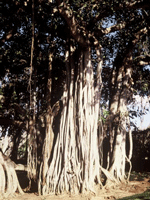
Botanical Gardens
gets its name
April 17, 1958
Nineteen acres of public land in Paget were renamed the Bermuda Botanical Gardens. Governor Sir John Woodall did the honours on the first day of the Agricultural Exhibition.
The name change was a reflection of the need to develop the gardens’ horticultural side after tourism supplanted agriculture as the island’s major industry.
The Botanical Gardens date back to1898 when ten acres of land known as the Public Garden were put under the control of Government’s Board of Agriculture.
In the same year, the first superintendent, G.A. Bishop, began laying out the grounds. The land was broken up into plots and research conducted over the years on a variety of plants—Easter lilies, onions, potatoes as well as peach trees, grape vines, cherries and apples—contributed to Bermuda’s success as a farming nation.
The Board even experimented with milk production from 1899, when a small herd of dairy cattle was imported.
In 1912, the Public Garden was renamed the Agricultural Station.
Between 1916 and 1918, as part of a continuing effort to improve cattle stock, Ayrshire and Guernsey bulls were imported and housed in what is now known as the J.J. Outerbridge building.
In 1921, with the acquisition of the Montrose property to the east, the Agricultural Station nearly doubled to 19 acres, and the following year, the first modern-day Agricultural Exhibition was held on the newly expanded grounds.
Six years later, the first horticulturalist was hired, although during the Second World War, crops and livestock took a back seat to horticulture.
In 1947, following the scale disaster that killed off more than 90 per cent of Bermuda’s cedar trees, the Board of Agriculture led the reforesting effort, handing out thousands of seedlings to homeowners.
The Station’s plant nursery was moved to Tulo Valley in 1957, the year Government acquired the kitchen garden of Admiralty House in Pembroke.
In 1959, a start was made on the garden for the blind but three years later, the Botanical Gardens had a setback when three acres were taken for the construction of the new hospital.
But in1965, Government acquired the Camden Estate, expanding the Gardens to its current 36 acres. It is now the Island’s fifth largest national park.
In 2006, Bermuda was in danger of losing 30 per cent of the Gardens to a new hospital but after a public outcry, the plan was shelved.
Source: The Royal Gazette, April 18, 1958; “The Bermuda Botanical Gardens” by Peter J. Truran, Bermuda’s Heritage (1983), Department of Community Services; Botanical Gardens Park Management Plan 2004.
|
| Born this month |
|
Wenona Grace Robinson
April 30, 1890-June 8, 1973
Elocutionist, speech teacher, founding member of the Sunshine League
|
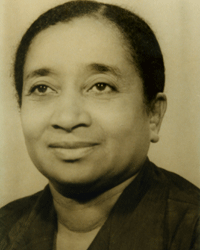
Wenona Robinson was adedicated Girl Guide leader who also helped found the Sunshine League.'
|
Born into a prominent family, Wenona Robinson was an elocutionist who took her training in public speaking on stage and into the classroom.
She was also a Girl Guide leader and a founding member and long-time treasurer of the Sunshine League, the children’s home started by her sister Agnes May Robinson in 1919.
Robinson was the eleventh of 13 children born to Samuel David Robinson and his wife Elmira Elitia Dowding (born Thomas) Robinson, and one of 10 who survived to adulthood.
Samuel David Robinson was a self-made businessman and landowner whose properties lined Princess Street in Hamilton. He was also a founder of the Berkeley Institute, which opened on September 6,1897.
Robinson lived all her life at Wantley, an elegant family residence that her father built on Princess Street, and where the plan to establish Berkeley was conceived.
Robinson, her sister Agnes, who was nearly five years older, and several other siblings, were among the first group of students—35 in all—to attend Berkeley Institute, even though she was only seven.
She completed her high school education at Albert College in Belleville, Ontario–Canada’s oldest boarding school. Robinson was at Albert between 1906 and 1908, and graduated with a diploma in speech.
Robinson returned to Bermuda, and to a life of community service, but she never put her speech training aside. As early as 1911, she was giving readings at musical and other cultural events staged at the Colonial Opera House in Hamilton, the major performing arts centre of its day. She was a regular on cultural programmes held at Opera House and other public stages, until the 1950s.
She also taught speech at Mrs. Millicent Neverson’s Excelsior Secondary School, offering her services shortly after the school was formed in 1926, because it “worried her,” Neverson later wrote, “to hear wrong pronunciation.”
Neverson, who established First Excelsior, Bermuda’s first black Girl Guide Company in 1931, introduced her to Guiding.
Robinson became a Guider in 1934, the same year that Neverson formed the Second Excelsior Girl Guide Company, in response to growing demand.
As a result of her association with Neverson, she became a Girl Guide leader. Neverson had established First Excelsior, Bermuda’s first black Girl Guide company, in 1931. She helped out at First Excelsior, under Neverson as captain, and Edith Crawford as lieutenant, or the second-in-command. When the Second Excelsior was formed in response to growing demand, around 1935, Robinson became its first captain.
Guiding got Robinson to the gates of Buckingham Palace. In April 1937, she attended the coronation of King George VI as chaperone for First Excelsior Girl Guide Rangers Doris (Heyliger) Corbin and Gaynell (Paynter) Robinson. The trio was a member of a larger delegation from Bermuda.
Her life was very much taken up with the Sunshine League. Serving under Agnes May as president, she was a member of the League’s first committee of management and was its treasurer for 28 years.
Robinson flirted with political activism as a member of the Bermuda Civic and Political Association, which was formed to help get women elected to Parliament after they won the right to vote in 1944. The Association had an interracial membership, which was a rarity for the period.
She also ran the School of Expression, a speech school, in the Arcade Building on Burnaby Street, Hamilton, which was owned by her father. She gave “courses of study” to children and adults in vocal expression, physical expression and mental expression.
In 1945, she became the first speech teacher at Central School (now Victor Scott), remaining on staff until her retirement in 1955. She continued her work with the Girl Guide movement—serving also on the executive of Bermuda Girl Guide Association—until the early 60s.
Robinson, who never married, died at King Edward VII Memorial Hospital on June 8, 1973 at age 83 after a lengthy illness and is buried at St. John’s Anglican Church in Pembroke, where her family worshipped.
For more about Robinson, see her full-length bio.
|
|
Previous Bermuda Biographies home pages by month:
|
|
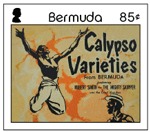
Troubadours’ stamp of approval
Entertainers who made their name—and earned their livelihood—during the heyday of tourism have been honoured with a stamp issue.
The first in a series of Bermuda Troubadors stamps was launched at the Post Office in March.
It pays tribute to calypsonians Sydney Bean and Celeste Robinson, pianist and big band leader Al Harris, The Four Deuces, Hubert Smith, Erskine Zuill and the Talbot Brothers.
The four stamps in the initial series feature the musicians’ album covers.
According to the Bermuda Philatelic Bureau: “This new series will create awareness of Bermuda’s legendary calypso singers.”
Bermuda gets
Heroes Day
Bermuda will celebrate its first National Heroes Day on October 13, and Dame Lois Browne-Evans will be the first Bermudian to be celebrated, Culture Minister Dale Butler announced. National Heroes Day will be a public holiday, which create a total of 11 for this year, but in 2009, the Queen’s Birthday holiday, which is celebrated in June, will be dropped.
The Queen’s birthday, which is actually in April, has been a public holiday for decades in Bermuda. Her birthday is celebrated in June in the UK because the weather is warmer, but unlike in Bermuda, the British don’t get a day off.
Fancy footwork
at the Ag Show
There’ll be the usual displays of poultry, pigs, petunias and parsley, not to mention cakes, kites, and horse jumping at the Annual Exhibition (formerly known as the Agricultural Exhibition and still referred to as “the Ag Show” by Bermudians). They’ll be sharing the spotlight with some highly acclaimed practitioners of fancy footwork.
The Dynamic Diplomats of Double Dutch, a group of female athletes who are said to put on an awesome skipping act, are the featured attraction.
The 70th Annual Exhibition will take place at the Botanical Gardens on April 17, 18 and 19. It is open from 8 a.m. to 6 p.m. Admission is $8 for adults and $4 for children and seniors.
^ Back to top
Tributes to a trailblazer
Tributes were paid to Roosevelt Brown on April 3, the first anniversary of his death in 2007. At a programme organised by admirers who have formed themselves into an organisation called Batho Pele (People First) and Government’s Department of Cultural Affairs, there were songs, readings and dances in memory of the man who is credited with mobilising public opposition to the property vote in the early 1960s.
The election of 1963, when everyone over age 25 received the right to vote, set the stage for the total abolition of the property vote in 1968.
Brown, who later changed his name to Pauulu Kamarakafego, was a Progressive Labour Party (PLP) organiser and former PLP MP, who later worked in developing countries through United Nations organisations.
Premier Dr. Ewart Brown presided over the programme at the Fairmont Hamilton Princess, where University of Maryland professor Acklyn Lynch delivered the keynote speech.
Southlands saved,
but future bleak
for Hamilton buildings
Environmentalists have applauded the land swap that will see a proposed Jumeirah hotel developed at Morgan’s Point, instead of at Southlands in Warwick.
The deal, announced in April, capped a campaign led by environmentalists throughout 2007, followed by a 12-hour intervention by former Premier Alex Scott on the eve of the election.
It will mean the 37-acre Southlands property will pass into Government hands and preserved as green space.
But that victory was overshadowed by the granting of another Special Development Order in Hamilton that will see a slew of buildings along Reid Street east and lower Court Street demolished to make way for a 10-storey hotel/condo development.
Concerns have also raised that the development will encompass Alexandrina Hall, which was built by Oddfellows in 1859, and played an important role in back Bermudian society for decades.
^ Back to top
|

