|
This month
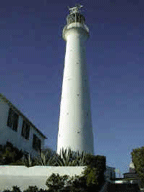
First light shines Bermuda’s first lighthouse was a welcome beacon for seamen who for three centuries had risked being shipwrecked off the island’s treacherous reefs. A lighthouse was first mooted in 1830. A report sent to the U.K. in 1839 showed the location of 39 wrecks, a 10-year record. Most were in the west end, and only four were bound for Bermuda. The lighthouse was erected under the administration of Governor William Reid by British convicts, who had been shipped off to Bermuda to serve their time and were housed in airless hulks off Dockyard. It was built in the U.K. and transported across the Atlantic and unloaded at a wharf near Gibbs Hill. A report in The Royal Gazette of its arrival said: “The ship with the Cast Iron Light House for Gibbs Hill arrived at Ireland Island at Wednesday last from London, and on Saturday proceeded through Stagg’s Channel to Port Royal. “The Light, which will be a revolving one, will stand at an elevation of 375 feet above the level of the Sea, and will be a most brilliant one. This will be the second Iron Light House in the world.” Work to erect the 117-foot lighthouse began in December 1845.The convicts cut a road up Gibbs Hill and dragged the heavy cast-iron sections along by hand. Lighting technology has changed over the years, and has long been automated. Views from the top are still breathtaking—for those with the stamina to climb 185 steps. Bermuda’s second lighthouse, which is half the height of Gibbs Hill’s, was built in St. David’s in 1879. Sources: Bermuda—Five Centuries by Rosemary Jones; Bermuda Journey by William Zuill, Bermuda Beacon by Henry Baker, The Bermudian, April 1952
|
|
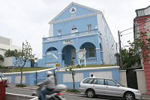
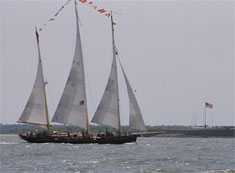
Heritage Under Siege It’s one of the ironies of life that the theme for this year’s Heritage Month 2008 is ‘Life in Old Bermuda’, for much of old Bermuda is being lost to the wrecking ball. The latest example of heritage under siege is Alexandrina Hall [pictured above], which dates back to 1852 and was built by members of the Grand United Order of Oddfellows lodge. Alexandrina Hall was the hub of black Bermudian society for more than a century, the venue for everything from weddings and socials to political meetings. But lodge membership has dwindled over the years, and trustees of Alexandrina Hall are said to be negotiating with developer Ramadhin Smith to sell the historic property. Still, ‘Life in Old Bermuda’ is what we are being asked to celebrate this month. Tales will be told all month about the good old days. An old-style Bermuda bazaar, like the kind that would have taken place at Alexandrina Hall, is also on the Heritage Month calendar. Bermuda Day will be celebrated on Monday, May 26 because May 24 falls on a Saturday. Festivities will kick off as usual with the Marathon Derby in the morning, while the parade will get under way at 1.30 p.m. It will begin at Albuoy’s Point and wind its way along Front Street, Court Street, Victoria Street and Cedar Avenue, ending up at Bernard Park. Culture Minister Dale Butler said: “We would like to take this opportunity to encourage the community to come out and participate in the Bermuda Day celebrations and welcome participation from all segments of the community.” For the story of the evolution of the Bermuda Day holiday, check out our May 2007 home page. Heritage is also the theme of Masterworks’ annual Art Festival, which will take place on Sunday, May 25 from 12 to 5 p.m. in the Botanical Gardens, Paget. There’s a big incentive for artists entering this year’s competition. Festival sponsor Butterfield Bank will hand out $2,500 in cash prizes to the best amateur artist and the best professional. It’s in celebration of the bank’s 150th anniversary. Winning entries will be displayed at the bank throughout June. The sail training vessel Spirit of Bermuda is heading south this month to Turks and Caicos for a “pilgrimage and community learning expedition.” Those making the journey will have a unique opportunity to reconnect with their history and heritage. In the 17th and 18th centuries, white Bermudian slaveholders sailed in sloops to Turks and Caicos with black slaves, who were put to work raking salt. It was backbreaking work that reaped huge fortunes for slaveholders because salt was a valuable commodity on the international market, used to preserve food, including cod. Spirit Of Bermuda will be in Turks and Caicos from May16 to 21. The ship will return to Bermuda via the Bahamas and Jacksonville, Florida. Bermudian slave Mary Prince raked salt in Turks and Caicos. Read the account of her triumph over slavery in The History of Mary Prince and check out her bio. Corporation has change of heart The Corporation of Hamilton has bowed to public pressure and will allow the Bermuda Society of Arts to remain in the space it has occupied since from 1958, the year City Hall was built. In yet another indication of heritage under siege, in January the Corporation gave the Society six months to quit the building because it needed office space. Corporation members were apparently unaware that the city fathers back then had set aside the space specifically for the gallery. The hue and cry from artists was such the Corporation had a chance of heart. They have now given the BSoA a five-year lease. BSoA president Edwin Smith was understandably relieved. He told the Mid-Ocean News: “We have individuals lining up for exhibits for '09 and we have been in a holding pattern because we didn't know if we could accommodate them or not. We can now breathe a little easier." |
|||||||||
| © 2008 Bermuda Biographies All rights reserved |
|||||||||||