First Portuguese immigrants arrive
November 4, 1849
On November 4, 1849, the first Portuguese immigrants arrived in Bermuda on board the ship the Golden Rule.
Although the Azores, which is located 800 miles from mainland Portugal, would later become the main source for Portuguese immigrants, the first immigrants came from the island of Madeira.
The 58, who were contracted to employers in various parts of the island, comprised 35 men, 16 women and seven children. The youngest was nine-years-old, and the oldest was 46. Their journey, the cost of which was subsidized by the Bermuda government, took 21 days.
Brought to Bermuda to work as farm labourers, they were said to be an “orderly and well behaved people and were obtained chiefly from the country.”
The Royal Gazette report of their arrival on November 6, 1849 said: “We sincerely trust this importation of labourers will answer the end contemplated; and we hope they will be the means of inducing the cultivation of the vine more extensively than at present.”
One year, after the arrival of the Golden Rule, the Portuguese community was celebrating its first birth. Maurice Terceira, son of Ignacio and Maria Terceira, was baptised at St. Mary’s Church in Warwick on November 24, 1850. Four couples were also married the same year.
Portuguese Bermudians have gone on to make their mark not only in agriculture, but in all sectors of Bermuda. They represent one of the three main groups to which most Bermudians belong. The others are black Bermudians, who trace their ancestry back to Africa, and white Bermudians who are descended from British settlers. Many Bermudians can claim ancestry from at least two of the groups, and some from all three.
Source: Portuguese Bermudians—An Early History and Reference Guide, 1848-1949, By Patricia Marirea Mudd.
|
| Born this month |
| Cyril Outerbridge Packwood
November 22, 1930-January 14, 1998
Librarian, historian, author
|
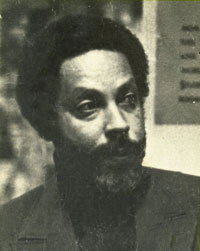
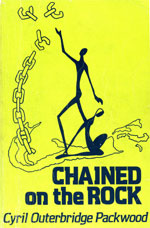
Cyril Packwood - and his ground-breaking book, Chanied On The Rock
|
Cyril Packwood was a librarian with a passion for history. He was the author of Chained on the Rock, the first definitive account of slavery in Bermuda.
Published in 1975, after Packwood spent several years doing painstaking research in the Bermuda Archives during summer vacations, Chained on the Rock shed light on an important aspect of Bermuda’s history that had previously been swept under the carpet.
He was born in Wellington, St. George’s, the only child of Cyril and Gladys (Outerbridge) Packwood. His father was a former St. George’s Cup Match cricketer. Packwood attended Temperance Hall, East End primary school and Berkeley Institute.
He left Bermuda at age of 15 to complete his high school education in the U.S., and with the intention of becoming a dentist. At Fisk University in Nashville, Tennessee, he came under the influence of Harlem Renaissance writer and historian Arna Bontemps and decided to study history.
Packwood received a bachelor’s degree in history from Fisk in 1953 and a master of science in library science from Case Western Reserve University in Cleveland, Ohio, a year later. He received a second master’s degree, in history, from Hunter College in New York in 1972.
He spent most of his professional life in New York. He worked in the New York Public Library system from 1957 to 1968 and from 1968 to 1985, at the Borough of Manhattan Community College Library, where he was supervising librarian.
In 1985, he was appointed head librarian of the Bermuda Library, the first black person to hold the position.
He breathed new life into the library. He organised evening lectures, instigated upgrades of its computer system and started a video rental system, all with the goal of bringing more people into the library. He was head librarian for eight years, until his retirement in 1993.
Packwood’s other books included Detour Bermuda, Destination U.S. House of Representative: The Life of Joseph Rainey, about the former slave who took refuge in Bermuda during the U.S. Civil War, and went on to become the first black member of the U.S. House of Representatives.
During his years in New York, Packwood lived near Lincoln Centre and enjoyed all the cultural pursuits the city had to offer, from opera to theatre.
His deep and abiding love for Bermuda was matched by his love of Africa. He led cultural tours of Africa for many years and had criss-crossed the African Continent.
He was married to Dorothy, an artist and fellow librarian. The couple had one daughter Cheryl Packwood, a Harvard University-educated lawyer, who is currently chief executive officer of the Bermuda International Business Association, and three grandsons.
Packwood died at age 67 of complications of heart bypass surgery.
|
|
Previous Bermuda Biographies home pages by month:
|
|
Bermudians will go to the polls on Tuesday, December 18. It will be the 11th election for Bermuda since the adoption of the two-party system and full universal adult suffrage since 1968.
Premier Ewart Brown is seeking a third term in office for his ruling Progressive Labour Party. Opposition United Bermuda Party, led by Opposition Leader Michael Dunkley, is hoping to win re-election after being out of power for nine years.
For more about the evolution of Bermuda elections and parliamentary democracy, see bios of W.L. Tucker, the father of the franchise bill, Sir Henry Tucker, Bermuda’s first government leader, and L. Frederick Wade, who laid the groundwork for the PLP’s first victory in 1998.
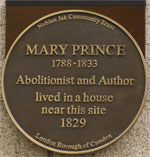
London honours
Mary Prince
Mary Prince, the Bermudian woman whose account of her life as a slave help galvanise the anti-slavery movement in the United Kingdom, has been commemorated in London.
In the year of the 200th anniversary of the abolition of the slave trade, her story of is also being recounted in an opera.
On October 26, a plaque was unveiled in her honour at the University of London’s Senate House. Mary Prince lived in a house on the site in 1829.
Prince, who was born at Brackish Pond, Devonshire, was the first woman to publish an account of her experiences as a slave. It created a storm of controversy and influenced the debate and eventual abolition of slavery.
The plaque was organised by the Nubian Jak Community Trust and the Camden Council to remember one of the borough’s most influential black residents.
Jak Buela, chief executive of the Nubian Jak Community Trust, said: “The Mary Prince story is one of remarkable courage and resilience and it’s fitting that within the bicentenary, this unsung heroine of the abolition movement should be honoured with a commemorative plaque.”
Camden Mayor Councillor Dawn Somper said: “Mary Prince was an inspirational woman and it is an honour to commemorate her life with a plaque.”
Prince’s life story is also part of the story line of the English Touring Opera’s production, Bridgetower, about the life of a brilliant 18th-Century black violinist George Bridgetower. The opera will tour the U.K. this autumn.
^ Back to top
Honour for former
headmistress
Southampton Glebe school has been renamed Dalton Tucker Primary School in honour of its former headmistress. Mrs. Tucker, aged 91, who began her teaching career in 1934, was principal of Southampton Glebe for more than 30 years. She retired in 1974.
The proposal to rename the school came from her former students.
Education Minister Randy Horton said at the renaming ceremony at the school in October: “"Today is a very, very special day. I'm here this morning filled with pride, representing the Government and a country that has selected one of our finest educators as the recipient of one of Bermuda's highest honours.”
"In particular, she had great interest in seeing that the young boys grew up doing what they needed to be doing.”
Mrs. Tucker was unable to attend the ceremony because of illness.
Mark Twain's
Bermuda
Mark Twain died in 1910, but his love affair for Bermuda lives on. Twain paid numerous visits to Bermuda from 1867 onwards, and now some of his impressions of the island have turned up in a compilation of quotations More Words That Make A Difference.
Authors Robert and Carol Greenman’s compilation of quotations were drawn from articles that appeared in the Atlantic Monthly magazine over the last 150 years.
Twain was captivated by “early twilight of a Sunday evening in Hamilton, Bermuda” and also of the Bermuda onion, the crop and the people. Bermudians began referring to themselves as onions because of their success with the crop that they supplied to the US before the era of tourism. More Words That Made a Difference can be purchased for $24 through Levenger Press’s website, www.levenger.com
^ Back to top
Window on History
at Dockyard
There’s always a historical happening at the Bermuda Maritime Museum. This month, the museum is exhibiting ‘Col. Hallewell’s Window on History’, rare lithographs depicting vistas of Bermuda between 1841 and 1888 by British officer, Col. Edmund Gilling Hallewell. The lithographs will be on show until December 12 in the Elliott Room at Commissioner’s House. The Museum is open daily, Sundays included, from 9am to 5 pm.
^ Back to top
|


